And a simple beginner-friendly method to help you play your very first song with just a few easy chords - no experience needed.
You don't need talent, perfect rhythm, or any musical background - you just need a clear first step.
Watch the full video above: "How any adult can play their first song starting from zero"
If you've never picked up a guitar before, chances are one of these thoughts has crossed your mind:
Every single one of those fears is completely normal. And every single one is solvable.
Most guitar instruction was designed for people who already want to learn. It skips right past the biggest obstacle adults face: the fear of even starting. Classes assume you know what a chord is. YouTube assumes you know what to search. Private teachers assume you have some baseline.
Nobody designed a method for the person standing at the very beginning, looking at a guitar and thinking: "I have no idea what I'm doing and I'm scared to find out."
My job is not to teach guitar. My job is to remove the fear of starting. Once that fear is gone the rest takes care of itself.
Most teachers start with technique and boring theory. They force you into "finger pain" before you even know why you're there. For a total beginner, that's an immediate setup for giving up before you've even really started.
"You don't build a house by starting with the roof. You start with one brick."
ONLY 1 Hand Movement Focus entirely on mastering just one strumming pattern.
ONLY A Handful of Simple Chords No complex bar chords. The basic DNA to unlock real songs.
50% Mindset Focus Mental rehearsals & focus statements so your brain does the work even when you're not playing.
I have only one obsession.
One mission.
One outcome I care about more than anything else.
You actually picking up a guitar and playing. For real.
Not watching videos and doing nothing.
Not "thinking about it" for another year.
Not talking yourself out of it before you've even tried.
I want a transformation.
I want you to actually become someone who can pick up a guitar and play songs.
I want you to go from "I have no idea what I'm doing" to "I just played my first real song" and feel that shift inside you.
You don't need to be a guitar legend. You don't need to know every song. You're just learning the basics, one small step at a time and that's how real progress happens.
Babies don't stand up and sprint on day one. They crawl. They wobble. They fall. And then one day they run.
Adults want to already know. Your brain picks up a guitar and whispers: "I should be better at this." And when you're not… you put it down. We're not doing that.
👉 Play 10 to 15 real songs. That's it.
Because once you can play songs, something magical happens. Confidence kicks in. You stop feeling like an outsider. You start exploring chords. You start experimenting. You become unstoppable.
"That's why we're doing something radical:
We're using ONLY one strumming pattern.
One pattern. Zero overwhelm. Maximum progress."
Once this becomes automatic, then you can explore other chords and strumming patterns. But not before.
"Remember: You're just getting started. Let's keep it simple. This is your starting line."
"Forget my face. Forget everything else.
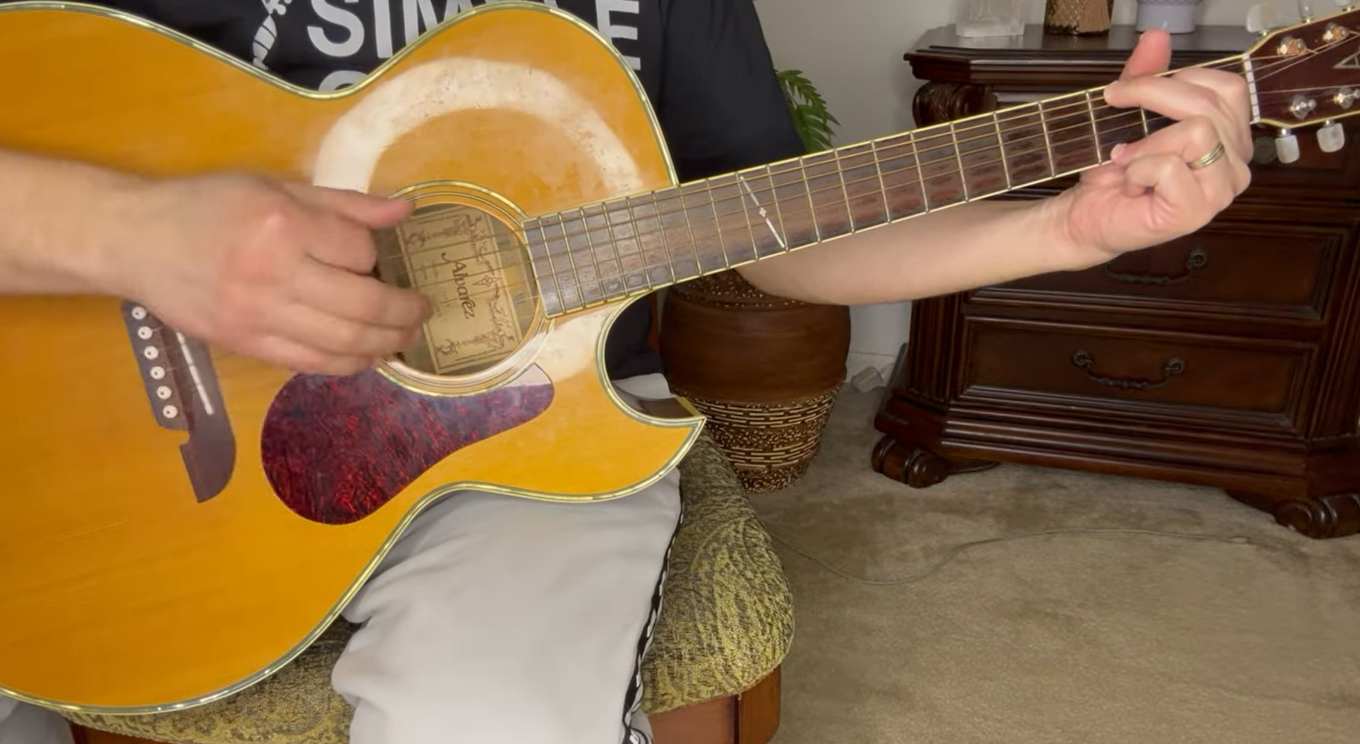
Notice this: I'm playing the SAME strumming pattern. The SAME simple chords. They keep repeating. I'm just moving my fingers slightly.
No crazy bar chords. No flying across the fretboard. No complexity. Just simplicity that sounds like music.
Watch. Listen. And realize: You can do this."
Let me tell you something that completely changed how I learned guitar.
There is no such thing as failure. There is only feedback. Read that again.
From childhood, we're programmed to fear failure. You fail a test and you feel stupid. You try a skill
and you think "Maybe this isn't for me."
And that single belief is why most adults never pick up a guitar in the first place.
Not because they're dumb.
Not because they're talentless.
Not because they lack discipline.
They never start because they're afraid of looking foolish.
Here's the truth elite performers know:
Every missed chord is feedback. Every buzzing string is feedback. Every time your fingers hurt or
the chord sounds wrong that is your brain learning.
"Failure isn't the opposite of success.
Failure IS the path to success."
The best athletes in the world don't fear mistakes. They collect them. Every missed shot, every stumble, every failed attempt is data. Your brain is literally using that information to wire itself for success. That's not failure — that's how learning works.
So when you play that D chord for the 100th time and it still sounds bad, don't get frustrated. Don't
put the guitar down. Don't say, "I'm not talented."
Instead, say: "GOOD."
Because every "mistake" is literally wiring your brain to play correctly.
Most courses never teach this. They teach technique and ignore psychology. That's why people
give up before they've really begun.
This system rewires how you think about learning.
And suddenly progress becomes inevitable.
This isn't just a guitar method.
It's a mental operating system for learning anything.
And once you understand this, fear of starting becomes almost impossible to hold onto.
You've been lied to.
You've always heard: "Practice, practice, practice. The more hours you put in, the better you get."
Sounds logical. Sounds disciplined. Sounds like success.
It's also the fastest way to burn out
and walk away.
So we're going to do the opposite.
I don't want you practicing eight hours a day. I don't want you cramming like it's a school exam.
And I definitely don't want you forcing progress.
Because that's not how the brain actually learns.
Real learning doesn't happen when
you're grinding.
It happens when you stop.
Research on learning shows that short, focused practice sessions spaced out over time dramatically outperform long, exhausting sessions.
This is called spaced practice, and studies show it can improve learning and retention by 20–40% compared to cramming.
"But here's the part almost nobody knows…
Your
brain practices while you sleep."
When you sleep, your brain literally replays what you practiced. It strengthens neural pathways. It
locks in muscle memory. It upgrades your skill without you touching the guitar.
Some people improve without any extra practice just because they slept.
"Harvard researchers discovered people improved their skills 10×
more just by sleeping after practice.
That's why my method spends 50% on mental
rehearsal and sleep-based consolidationso your brain practices even when
you're not holding the guitar."
Before you fall asleep, use our proven mental rehearsal method. While you sleep, your brain continues practicing for results most beginners never see.
Remember when I said this method is completely different? Here's what I meant.
We spend 50% on technique… and 50% on your mind.
Most courses jump straight into: "Here's a D chord. Memorize this. Practice
harder."
That's like going on a first date and proposing the same night.
It ignores how humans actually learn. So we're flipping the system.
Michael Phelps is the most decorated Olympian in history. 23 Olympic gold medals. 28 total medals. More than any human who has ever lived.
But here's what most people don't know: He trained in his mind as much as he trained in the pool.
Before going to sleep, his coach guided him into a deeply relaxed state. Then Michael would mentally rehearse every race stroke by stroke, turn by turn, finish by finish. He "swam" the race hundreds of times in his mind before ever stepping onto the starting block.
By the time he competed, his brain had already done it. So when the race started, his body just went on autopilot. That's Mental Performance Rehearsal.
The Science
A study conducted by Dr. Biasiotto at the University of Chicago split people into three groups and tested how many free throws they could make.
After 30 days, Group 1 improved by 24%.
Group 2 improved by 23% without touching a basketball!
Your brain literally cannot tell the difference between a vividly rehearsed experience and a real one. So we're using the same system applied to guitar.
Another secret? One of the biggest reasons people never start guitar or give up early is lack of focus.
They jump from YouTube video to YouTube video. They read forums. They try ten techniques at once.
It's like building a house by starting with the roof, then adding a door, then asking strangers online for opinions. Nothing gets finished.
So we use Focus Statements
Simple, powerful mental cues that keep your brain locked on the next tiny task.
Think of it like a GPS. You don't need to know every turn of the entire journey before you leave the driveway. You just need the next instruction. Focus Statements give your brain exactly that — one clear direction at a time, so you're always moving forward without overwhelm.
With Focus Statements, your brain always knows exactly what to do next. Paired with our mental rehearsal exercises, you start practicing on autopilot — so when you pick up your guitar, your fingers already know what to do before your conscious mind catches up.
Teach technique only.
They ignore the brain the control center of everything you do.
This is why elite athletes, Navy SEALs, and top performers use mental training. And now, so will you.
"Most guitar courses teach your fingers. This system trains your fingers and your brain."
I could see it.
Sitting by a campfire.
The flames dancing in the dark.
Friends laughing. Someone listening
quietly, smiling, impressed.
I could feel the warmth of the fire on my face…
Hear the soft crackle of wood…
Smell the smoke
in the air…
Taste the night breeze mixed with roasted marshmallows.
In my mind, it felt real.
It felt like who I was meant to become.
And I wanted it more than anything.
So I did what everyone does. I signed up for lessons. I trusted the experts. I followed the "right way."
And I hated every second of it.
The first week?
Music theory. Pages and pages of boring symbols.
I literally fell asleep in class thinking:
"I came here to play songs… not become a music professor."
Then came the guitar. The teacher told me to buy one but gave zero guidance. So I bought a random guitar.
Big mistake.
The strings were so high off the neck that pressing them felt like jamming my fingertips into a cactus.
My fingers burned. My hands cramped. Every note felt like pain and frustration. And the song we learned? Something my great-grandmother probably sang in 1800.
I was crushed.
I thought:
So I quit.
And in frustration… I smashed my guitar.
A month later, I heard my cousin's husband a professional musician play guitar.
And it all came flooding back.
That campfire dream. That feeling of being the person who can play.
I tried his guitars… and one felt different.
My fingers didn't hurt.
The pain was 95% gone.
For the first time, I thought: "Wait… maybe it wasn't me."
That night, I
made a decision.
I will figure out how to play guitar no matter
what.
There was no YouTube back then. So I bought every book, every course, every guide I could find.
And I got overwhelmed.
So I did something crazy. I ignored everything.
I picked ONE simple movement and said:
"I won't learn anything else until I master this."
"I fear not the man who practiced 10,000 kicks once, but the man who practiced one kick 10,000 times."Bruce Lee
That became my rule: master just one strumming pattern, even if it took 1,000 tries.
Then I discovered something shocking.
Most songs use the same simple chords over and over.
So I hunted for the most common ones.
I discovered that just a handful of easy chords can unlock more songs than most beginners ever imagine. You can start playing real music with just a few simple chords — and build from there at your own pace.
And suddenly… I was playing real songs.
But there was another problem nobody talks about.
Accountability.
No teacher. No deadlines. No tests.
"I'll practice tomorrow" turned into weeks of nothing.
I felt guilty.
I promised my mom I'd learn. The guitar was expensive.
I felt like I was letting her down.
So I made a promise:
"Whatever the obstacle is I will overcome it."
I wasn't talented.
Things never came easy to me.
But I was stubborn.
And stubbornness changed everything.
One day I saw a horse wearing blinders.
The officer told me:
"They wear these so they don't get distracted. They only look forward."
That hit me. That's what beginners need.
Focus. • Simplicity. • One path forward.
That's how the Simple Guitar Method was born. If most adults never even start because the whole thing feels overwhelming and scary then the system is broken. So I flipped everything upside down.
This is not a course.
This is a guided
transformation.
I'm not a professional musician. I can't play Mozart. I can't play every song.
But I can play guitar.
And you can too.
You just need a system built for real humans starting from zero.
My only goal is this:
I smashed my first guitar in frustration.
Now I teach beginners the exact opposite of what made me want to quit.
Everything about this method is designed for the person who has never touched a guitar and is scared to start.
From childhood, we're taught failure is bad. Wrong. There is no failure, only feedback. When you mess up a D chord for the 100th time, drop the ego, laugh, and say "GOOD". Every stumble brings you closer to playing.
"Practice 8 hours a day" is a myth for beginners. We use Spaced Practice. Mentally rehearse before bed. While you sleep, your brain replays and hardwires the skills. Practice a little, then stop.
Police horses wear blinders so they don't get distracted by the carnival. We do the same. No forum-hopping, no random YouTube rabbit holes. We master one step at a time.
No prior experience. No musical background. Just the method.
I picked up a guitar once at 47 and put it right back down. Three weeks into this method I played my first full song for my daughter. She cried. So did I.
I always told myself I wasn't musical. Turns out I just never had the right starting point. By week two I was actually playing something that sounded like music.
The mental rehearsal stuff sounded like nonsense to me at first. Then I noticed my fingers knew what to do before I consciously told them. That's when I became a believer.
I have arthritis in my left hand and assumed guitar was off the table forever. The hand hacks in this course changed everything. I'm not fast, but I'm playing.
What got me was how little time it actually took. I'm a busy dad. 15 minutes a day and I was making real progress. Other courses made me feel like I needed hours I didn't have.
I spent years watching YouTube videos and going nowhere. One strumming pattern, a few chords, and actual accountability. That's all it took. I wish I'd found this sooner.
Every second you wait is another day you're not playing. But here's the power:
You can claim your spot right now.
Scroll down, pick your spot, and your brain starts rewiring itself.
You're no longer imagining you're committing. Your future self is already strumming.
Every chord you master, every mental rehearsal you do, makes giving up impossible. Do it now.
A decent private teacher runs $80–$120 per session. That's $480–$720 for just six weeks — and that's assuming they show up, you click, and they actually know how to teach a total beginner (most don't).
The Simple Guitar Method costs less than that combined — and it's the only thing in that equation built specifically for you, starting from absolute zero.
No wasted sessions. No "come back next week and we'll try again." Just a clear, brain-first path from never touched a guitar to playing your first real song.
Bite-sized modules & group accountability
Or 3 easy payments of $333
Only 50 spots available
For those who absolutely refuse to stay stuck.
Application Required • Extremely Limited
Zero. This method was built specifically for adults who have never touched a guitar. No music theory, no prior knowledge, no baseline required. We start from the very beginning together.
Whether you have large hands, stubby fingers, or arthritis, you are not alone. There are hacks and alternative fingerings (shortcuts) that make playing painless. We bypass the physical frustrations entirely.
Neither did I. I smashed my first guitar over a fence. This isn't about talent; it's about sequence, accountability, and brain-first mental rehearsals. If you can follow a GPS, you can play.
No. Adults actually learn differently than kids and when you understand how your brain works, that's an advantage. This method is designed for the adult mind. Age is not a barrier; it's just a starting point.